
Services: Concept, Creative and Design, Front End, Back End, Technology Direction
Key Takeaways
- Novel take on pedagogy to increase participation and student expression and accessibility
- Disrupts the typical Learning Management System bloat and discursion
- Overwhelmingly positive student and instructor feedback
This platform is currently still in development and design but will be launched in a lean MVP format for Spring 2026
Playwise LMS is a custom learning management system designed to operationalize the Read / Watch / Play (RWP) pedagogy—an approach to learning that treats education as an experiential, expressive, and exploratory process rather than a linear pipeline of content delivery. The project emerged from early conversations with Dr. Caro Williams-Pierce, whose work on RWP challenged conventional LMS structures and inspired a rethinking of how platforms might better support creative, reflective learning.
I served as project lead, systems thinker, and educator, working in close collaboration with graduate students across branding, UX/UI, frontend, and backend development. My role spanned pedagogy translation, product direction, technical decision-making, and long-term considerations around maintenance, onboarding, and scalability.
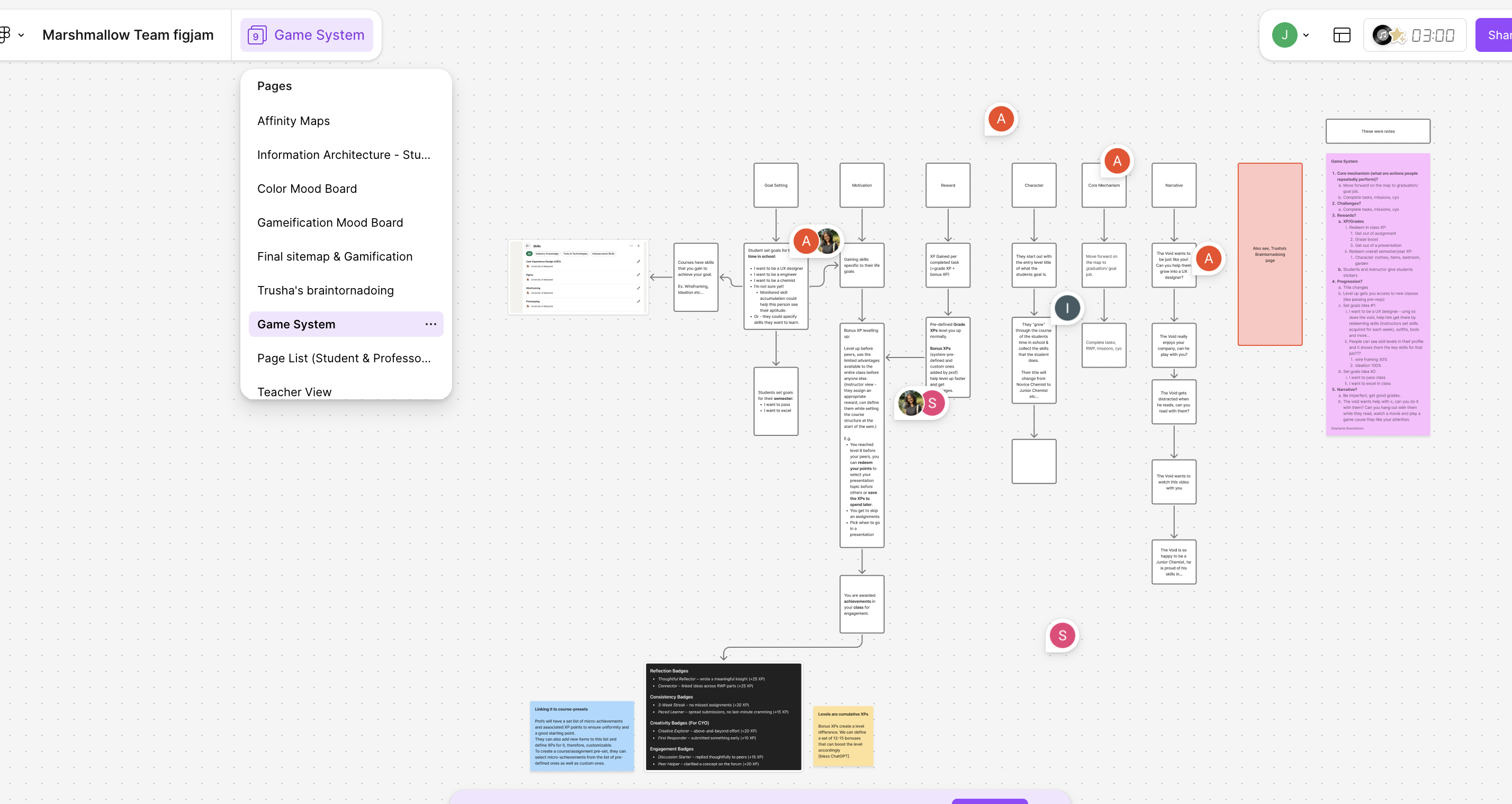
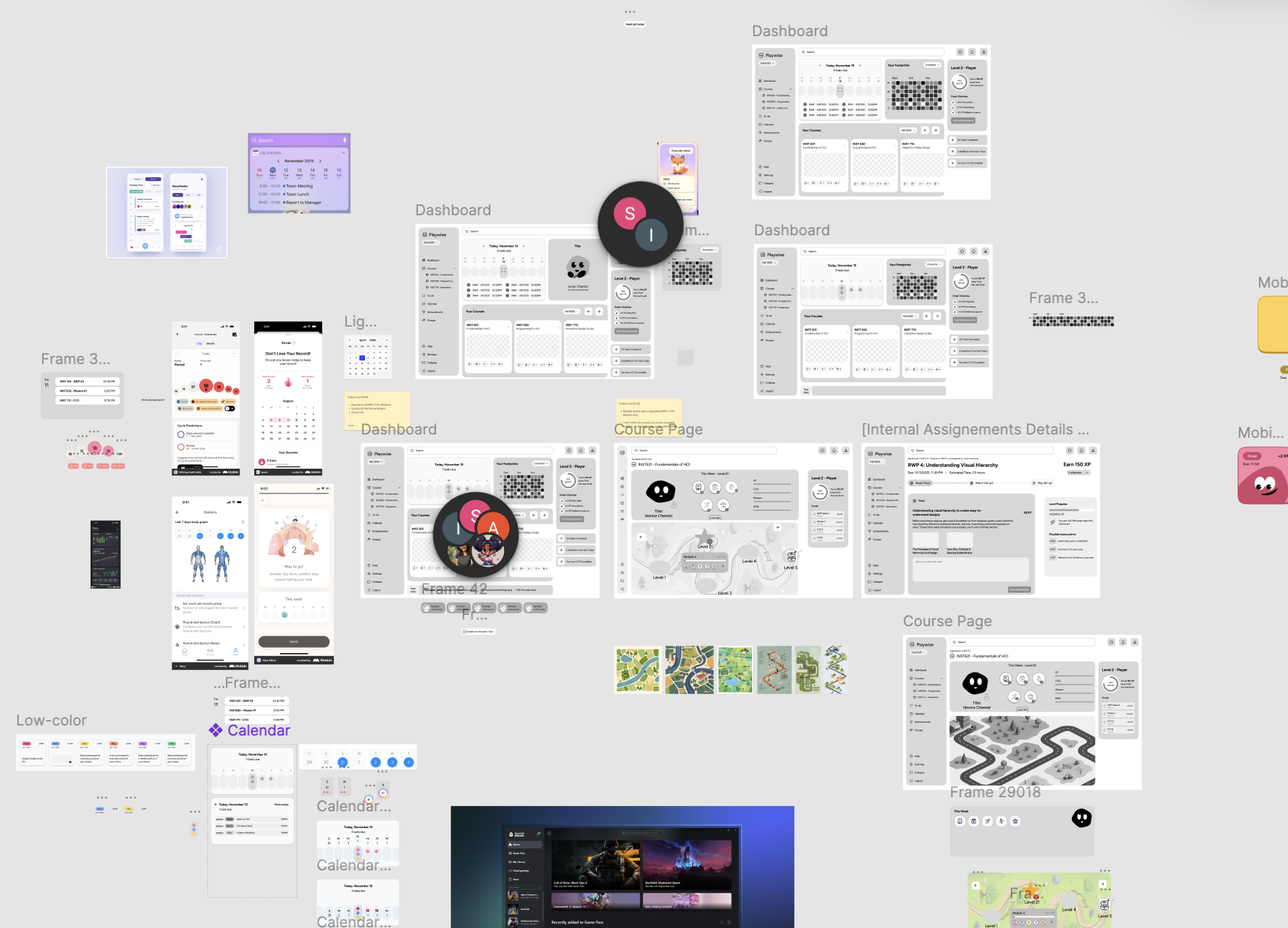
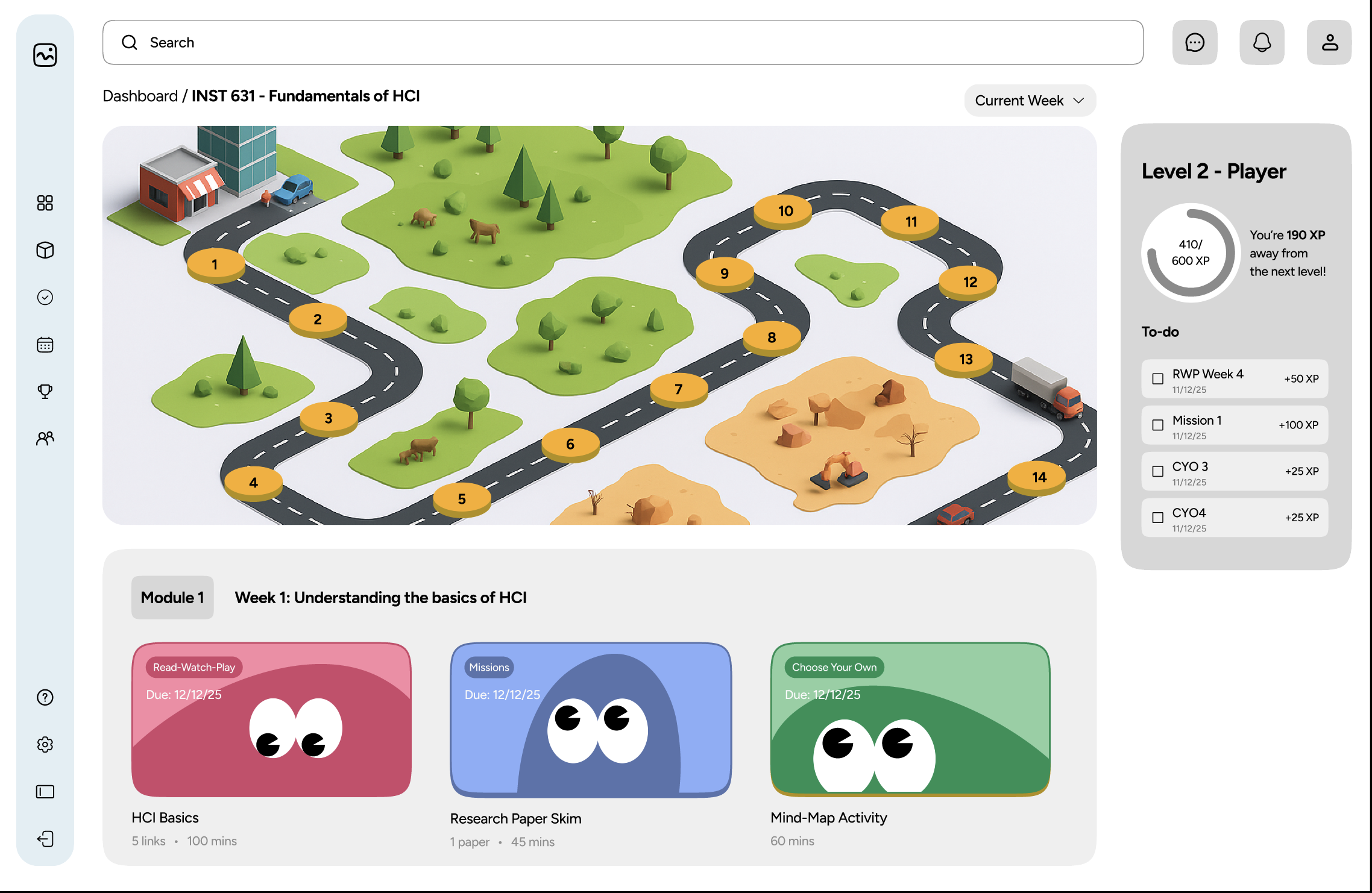
Most institutional LMS platforms—Canvas in particular—optimize for administrative clarity and compliance. While effective at managing logistics, they often feel rigid, corporate, and congested, subtly shaping learning into a transactional process. The core challenge was resisting Canvas as a design baseline and instead reimagining an LMS from the ground up, one that could remain structurally sound while making space for play, ambiguity, and personal expression.
This required both instructors and students to unlearn familiar LMS patterns—an intentional but risky design decision.
Playwise LMS was built as a flexible, modular system rather than a prescriptive workflow. Instructors can use it as a lightweight, traditional LMS—or push further, shaping courses that accommodate a wide spectrum of student responses and creative outputs. The interface was deliberately designed to feel less corporate and more playful, reducing cognitive friction and encouraging exploration.
To meet an aggressive launch timeline, the MVP constrained some of the system’s more experimental affordances in favor of pedagogical clarity and reliability. This tradeoff ensured the platform could support real classrooms while leaving room for future expansion.
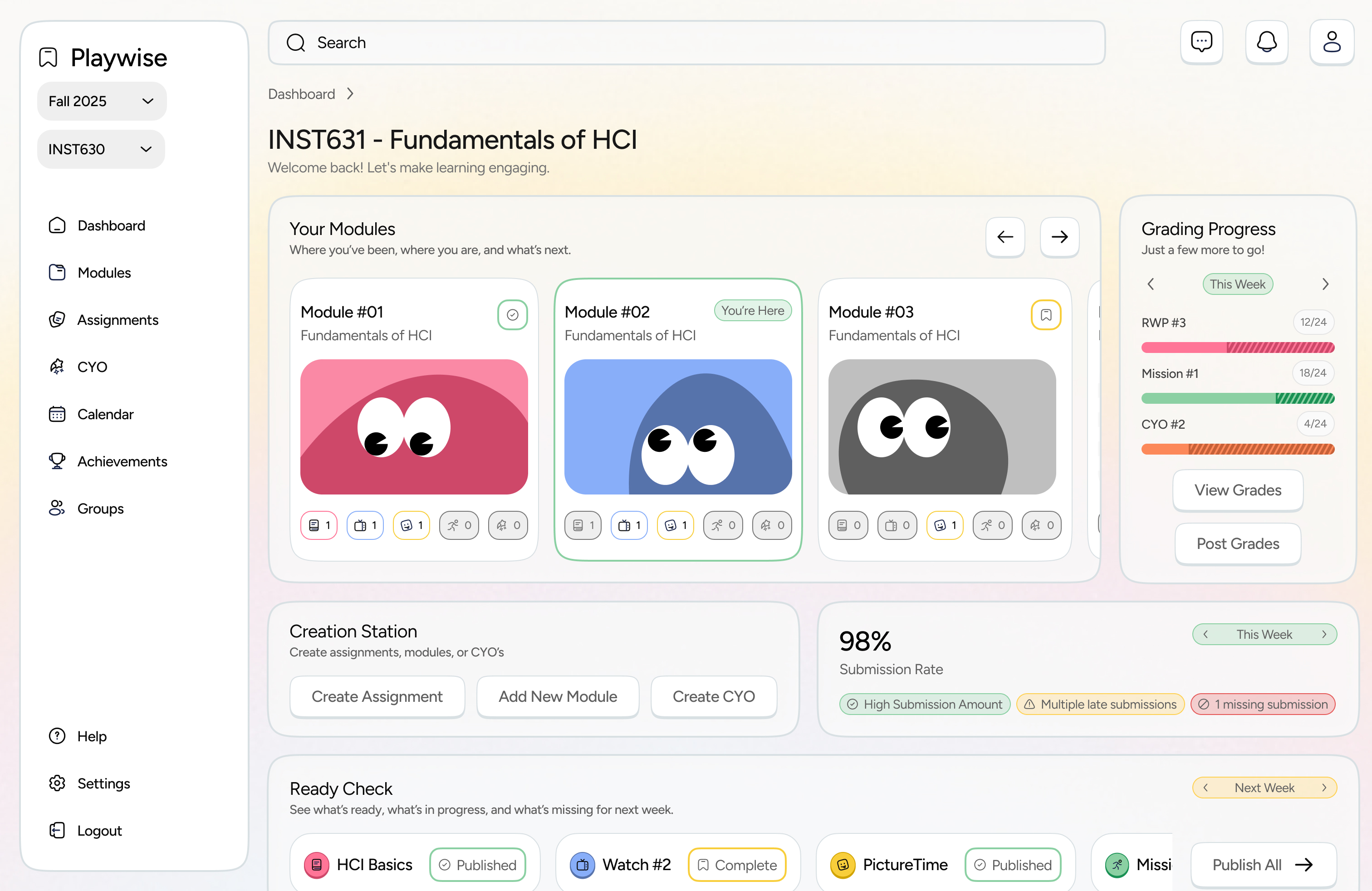
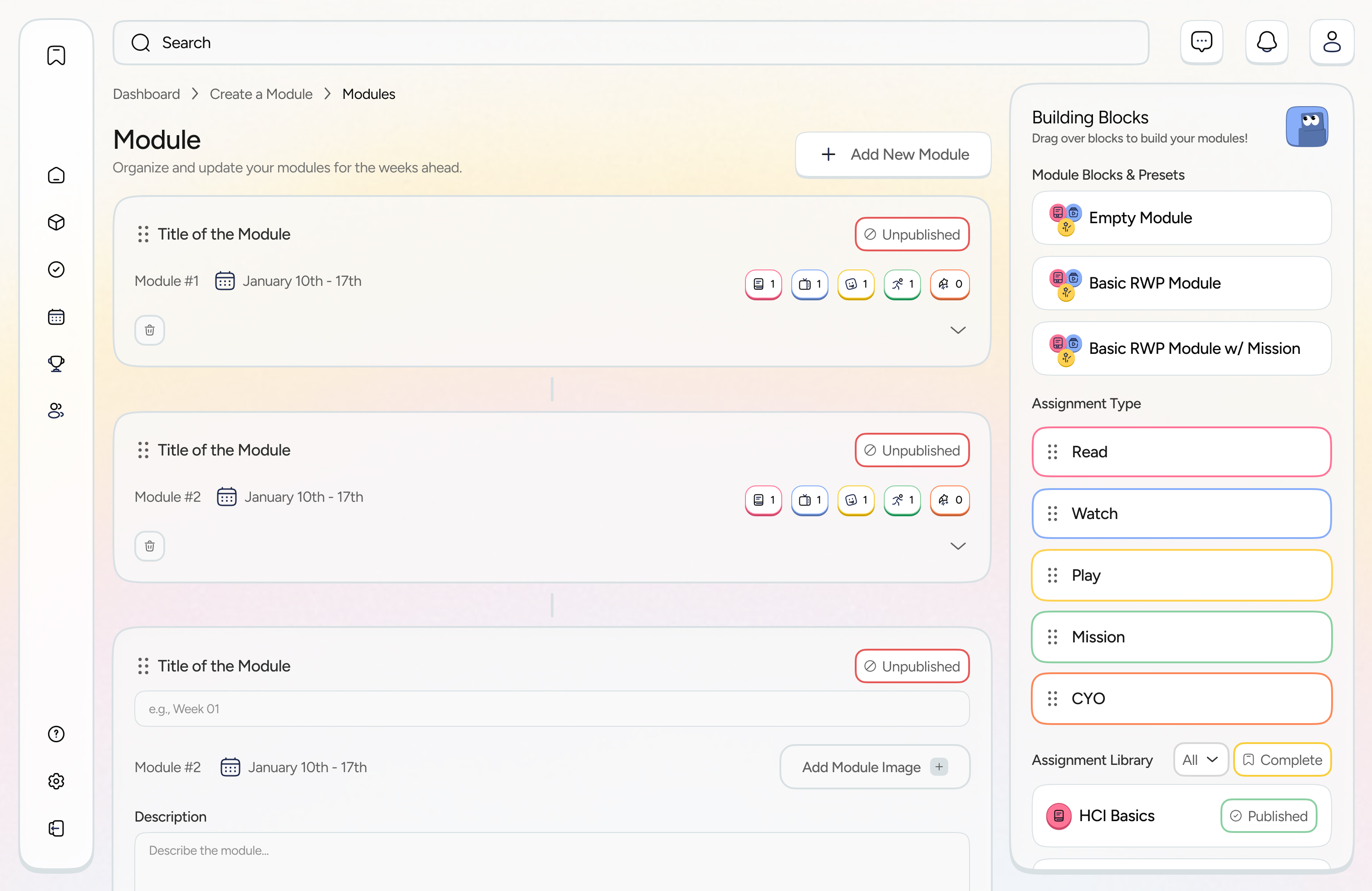
The MVP is currently in active pilot, launching in a limited capacity across 7 classes and approximately 100 students in the coming semester. Early feedback has been strongly positive. Students consistently describe the platform as more enjoyable and less oppressive than Canvas, and they respond particularly well to the RWP structure—framing learning as an experience of growth, reflection, and expression rather than a straight line from point A to point B.
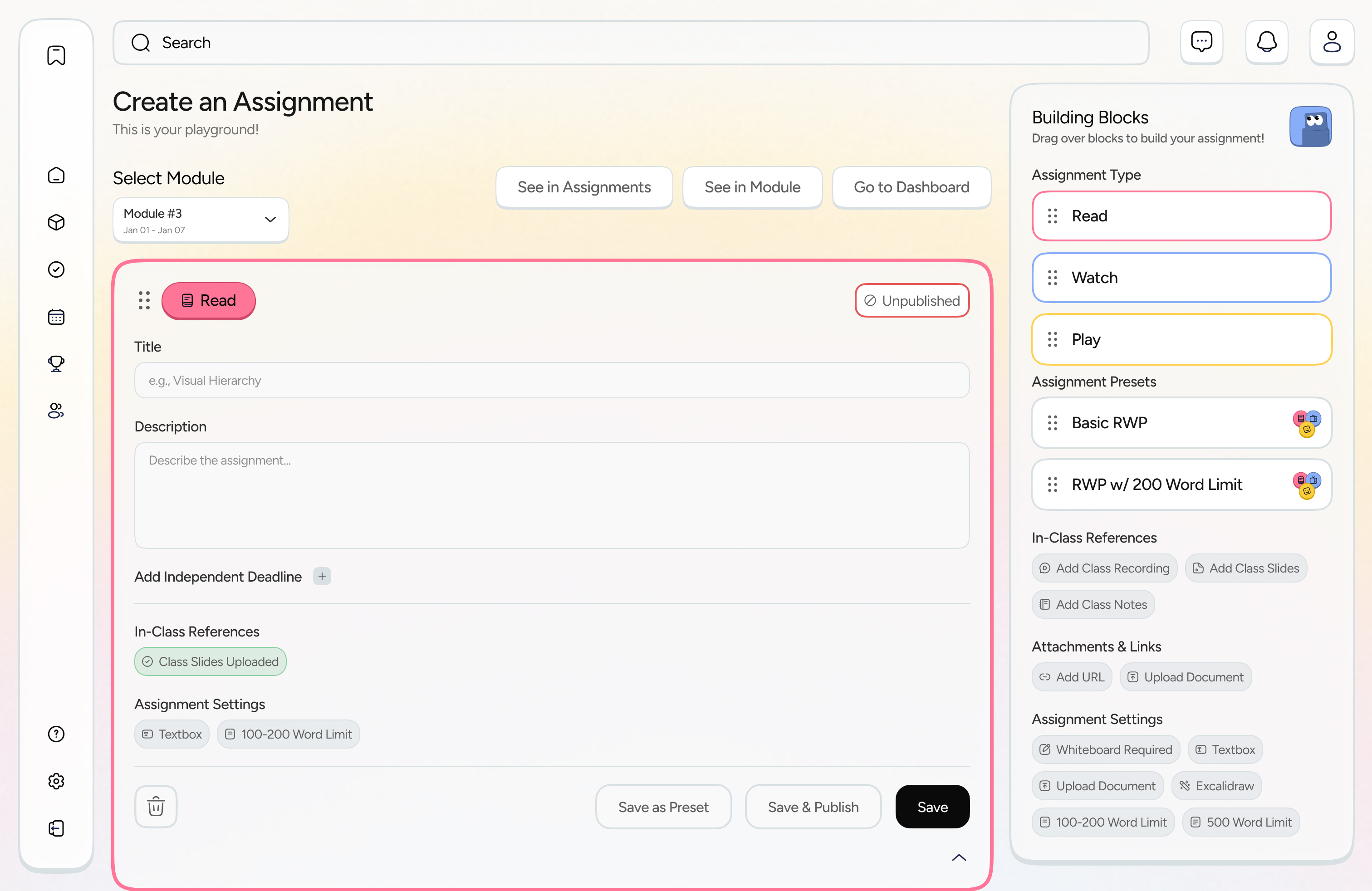
While the system requires an initial adjustment period, both instructors and students report that its flexibility quickly outweighs the unlearning curve.
Playwise LMS intentionally “scratches the surface” of what it aims to become. Its current success lies not in feature completeness, but in proving that pedagogy can meaningfully shape platform design—and that learning systems can be rigorous without being rigid.
Technologies: Figma, Next.js, React, Tailwind CSS, ShadCN, Supabase, Vercel, Notion